


THE BANK

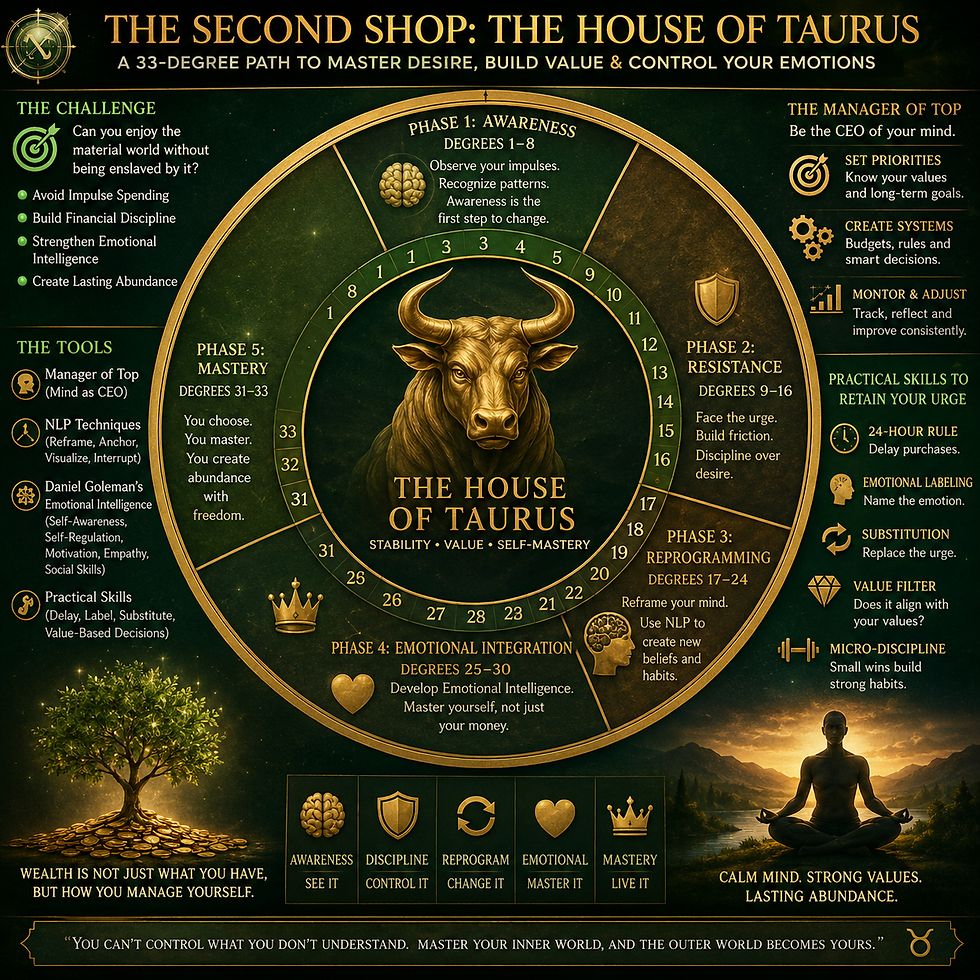
The Second Shop: The House of Taurus
A 33-Degree Path Toward Mastery of Desire, Discipline, and Emotional Intelligence
I. Introduction: The Gate of the Second Shop
The “second shop,” symbolically aligned with the House of Taurus, represents one of the most fundamental arenas of human development: the relationship between the self and the material world. It is not merely about money, possessions, or financial survival—it is about value. What we value, how we value it, and how those values shape our behavior, identity, and emotional life.
Taurus, in its archetypal dimension, governs stability, accumulation, pleasure, and physical experience. It is the force that builds, sustains, and preserves. But it is also the force that clings, resists change, and seeks comfort at all costs. This duality creates a central tension: the pursuit of security versus the risk of stagnation.
The metaphor of the “33 degrees” introduces a structured path of progression. Each degree represents a stage of awareness, confrontation, and refinement. Moving through them is not automatic; it requires conscious effort, discipline, and a willingness to confront uncomfortable truths about one’s habits and emotional dependencies.
The second shop is therefore not a place—it is a process. It is where the individual learns to interact with the material world without being dominated by it. It is where desire is neither suppressed nor indulged blindly, but understood, shaped, and ultimately mastered.
II. The Nature of Taurus: Stability and Attachment
Taurus is often associated with persistence, patience, and groundedness. These qualities make it one of the most stabilizing forces in human behavior. It allows for long-term planning, consistent effort, and the slow accumulation of resources.
However, the same qualities that create stability can also produce rigidity. The desire for comfort can become an avoidance of growth. The need for security can become fear of change. The appreciation of pleasure can turn into dependency.
At its core, Taurus operates through the body and the senses. It seeks tangible experiences: food, comfort, beauty, and ownership. These are not inherently negative. In fact, they are essential to human well-being. The challenge arises when these experiences become substitutes for deeper fulfillment.
The unrefined Taurus individual may:
Spend impulsively to regulate emotions
Avoid discomfort by seeking constant pleasure
Accumulate possessions as a form of identity
Resist necessary change due to fear of instability
The refined Taurus individual, by contrast, embodies:
Calm self-control
Appreciation without attachment
Strategic accumulation of resources
Emotional stability independent of material conditions
The journey through the second shop is the transformation from the first state to the second.
III. The Structure of the 33 Degrees
The 33 degrees represent a symbolic ladder of development. Each degree is not a rigid step but a layer of understanding that builds upon the previous one. The progression can be divided into five major phases:
Awareness
Resistance
Reprogramming
Emotional Integration
Mastery
Each phase introduces new challenges and requires different tools.
IV. Phase One: Awareness of Impulse (Degrees 1–8)
The first phase is deceptively simple. It does not require change—it requires observation.
At this stage, the individual begins to notice patterns:
Impulsive purchases
Emotional spending
Automatic habits
These behaviors often operate below conscious awareness. A person may believe they are making rational decisions, when in fact they are reacting to emotional triggers such as stress, boredom, or insecurity.
Awareness is uncomfortable because it reveals inconsistency. One may realize that their actions do not align with their stated goals or values. This creates cognitive dissonance.
The key challenge of this phase is honesty. Without judgment or justification, the individual must observe:
What triggers spending?
What emotions are present?
What thoughts justify the behavior?
This phase lays the foundation for all future progress. Without awareness, discipline becomes superficial and unsustainable.
V. Phase Two: Resistance and Friction (Degrees 9–16)
Once awareness is established, the next step is resistance. This is where the individual attempts to change behavior.
Common strategies include:
Creating budgets
Limiting discretionary spending
Avoiding unnecessary purchases
However, resistance introduces friction. The individual begins to experience internal conflict:
“I want this, but I shouldn’t buy it.”
“I deserve this reward.”
“What if I miss out?”
This phase is characterized by struggle. The desire for immediate gratification clashes with long-term goals.
Many individuals fail at this stage because they rely solely on willpower. Willpower is limited and easily depleted. Without deeper psychological changes, resistance feels like deprivation.
The purpose of this phase is not perfection but exposure. It reveals the strength of existing habits and the emotional forces behind them.
VI. Phase Three: Reprogramming Through NLP (Degrees 17–24)
To move beyond constant struggle, the individual must change the underlying patterns of thought and perception. This is where Neuro-Linguistic Programming (NLP) becomes valuable.
NLP focuses on how internal language and mental representations shape behavior. By altering these patterns, one can change emotional responses and actions.
1. Reframing Meaning
Instead of viewing restraint as loss, it is reframed as gain:
Not spending becomes an act of empowerment
Saving becomes an investment in freedom
This shift reduces the emotional tension associated with discipline.
2. Anchoring Positive States
Anchoring involves associating a specific emotional state with a physical or mental trigger.
For example:
Feeling pride when saving money
Experiencing satisfaction from control
Over time, these associations become automatic, replacing the emotional reward previously linked to spending.
3. Pattern Interruption
When an impulse arises, it is interrupted before it leads to action.
Techniques include:
Pausing for a set amount of time
Changing physical environment
Engaging in an alternative activity
This breaks the automatic link between urge and behavior.
4. Visualization of Consequences
The individual vividly imagines:
The long-term benefits of restraint
The negative consequences of impulsive behavior
This strengthens motivation and reinforces new patterns.
VII. Phase Four: Emotional Intelligence Integration (Degrees 25–30)
While NLP addresses cognitive patterns, emotional intelligence addresses emotional awareness and regulation.
Daniel Goleman’s framework identifies five key components:
1. Self-Awareness
The ability to recognize one’s emotions in real time. This includes identifying subtle triggers that lead to impulsive behavior.
2. Self-Regulation
The capacity to manage emotional responses. This does not mean suppression, but conscious control.
The individual learns to:
Tolerate discomfort
Delay gratification
Respond rather than react
3. Motivation
A shift from external rewards to internal goals. The individual becomes driven by long-term purpose rather than immediate pleasure.
4. Empathy
Understanding others reduces comparison and status-driven consumption. The need to impress diminishes.
5. Social Skills
The ability to navigate social pressure:
Declining unnecessary expenses
Avoiding competitive consumption
Maintaining boundaries
This phase transforms discipline from a struggle into a skill.
VIII. Phase Five: Mastery and Integration (Degrees 31–33)
In the final phase, control becomes natural.
The individual no longer experiences:
Constant internal conflict
Strong impulsive urges
Instead, there is:
Calm awareness
Intentional decision-making
Stable emotional state
Desire is not eliminated—it is understood. The individual can enjoy material experiences without dependency.
Money becomes:
A tool for stability and opportunity
Not a source of identity or validation
This is the highest expression of Taurus: grounded, steady, and free.
IX. The “Manager of Top” Method
The “manager of top” represents executive control over one’s internal system.
Rather than relying on motivation, the individual creates structure.
1. Clear Priorities
Define values
Establish long-term goals
2. Systems and Rules
Spending limits
Decision frameworks
Budgeting strategies
3. Monitoring and Feedback
Tracking behavior
Reflecting regularly
Adjusting strategies
This approach reduces reliance on willpower and increases consistency.
X. Practical Techniques for Retaining the Urge to Spend
1. The 24-Hour Delay Rule
Postpone non-essential purchases to reduce emotional intensity.
2. Emotional Labeling
Identifying emotions weakens their influence.
3. Substitution
Replace spending with alternative activities.
4. Value-Based Decision Making
Align actions with long-term goals.
5. Micro-Discipline Training
Practice small acts of restraint to build capacity.
XI. The Deeper Psychological Layer: Self-Worth
At its deepest level, the House of Taurus is about self-worth.
Many patterns of overconsumption are driven by:
Insecurity
Need for validation
Emotional emptiness
Possessions become symbols of identity.
True mastery requires recognizing that:value is intrinsic, not acquired.
When this understanding stabilizes:
External validation loses power
Spending becomes intentional
Emotional stability increases
XII. Conclusion: Mastery of the Material Self
The second shop is not about rejecting the material world. It is about engaging with it consciously.
The journey through the 33 degrees transforms:
Impulse into awareness
Desire into choice
Consumption into strategy
Emotion into intelligence
The integration of:
Discipline
NLP techniques
Emotional intelligence
Structural thinking
creates a state of grounded autonomy.
In this state, the individual is:
Stable without rigidity
Enjoying without dependency
Wealthy in both material and psychological terms
The House of Taurus, therefore, is not merely a domain of resources—it is a domain of self-mastery within the physical world.
Comments