


WHAT SERVICE LIKES, OR DEALING WITH LIMITS

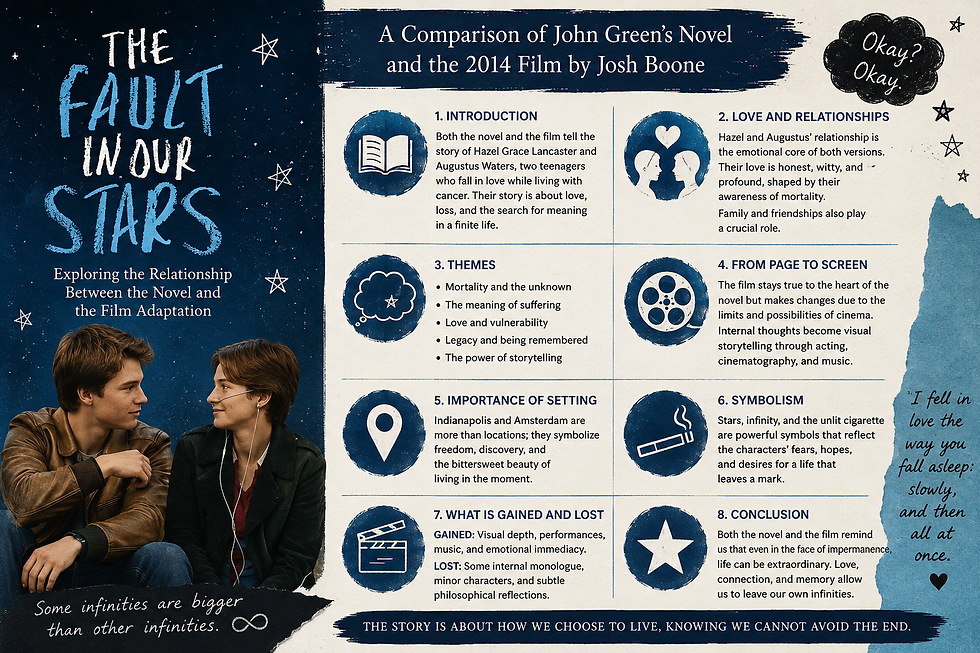
The Relationship Between John Green’s Novel and the Film Adaptation of The Fault in Our Stars
Introduction
John Green’s The Fault in Our Stars, first published as a novel in 2012, is a coming-of-age story that explores love, illness, mortality, identity, family, suffering and the search for meaning. Two years after the publication of the novel, the story was adapted into a feature film directed by Josh Boone, with Shailene Woodley portraying Hazel Grace Lancaster and Ansel Elgort portraying Augustus Waters. The film was written by Scott Neustadter and Michael H. Weber and became a major commercial and cultural success.
At first glance, the relationship between the book and the film appears relatively straightforward: the movie tells essentially the same story as the novel. Hazel Grace is a teenager living with terminal cancer who attends a cancer support group, where she meets Augustus Waters. The two develop a close friendship that gradually becomes a romantic relationship. Their relationship is complicated by their illnesses and their awareness that their futures are uncertain. Their journey takes them to Amsterdam, where they meet the author of Hazel’s favourite novel, An Imperial Affliction. Eventually, Augustus’s cancer returns, and Hazel must confront the death of someone she loves.
However, a film adaptation is never simply a visual copy of a book. A novel and a film use fundamentally different forms of communication. A novel can enter a character’s mind through narration, description and internal monologue, whereas a film must communicate thoughts and emotions through acting, dialogue, cinematography, music, editing and visual symbolism. The challenge facing the filmmakers was therefore not merely to reproduce Green’s plot, but to translate the emotional and philosophical experience of the novel into a cinematic form.
This essay argues that the 2014 film remains remarkably faithful to the central ideas, characters and emotional structure of Green’s novel, while necessarily altering aspects of the narrative. The differences between the two versions demonstrate that successful adaptation does not require complete literal fidelity. Instead, the film translates the novel’s central themes into another medium. In doing so, both works examine the same fundamental question: how can human beings create meaning and experience love when they know that life is temporary?
The relationship between the novel and film is therefore best understood as one of translation rather than duplication. The film retains the novel’s principal narrative and thematic concerns while using specifically cinematic techniques to express ideas that Green originally communicated through language.
The Novel and Its Adaptation
The Fault in Our Stars occupies an unusual position within young adult literature because, although it contains many conventions of the romantic coming-of-age story, its central characters are confronted with an unusually serious question: mortality. Hazel and Augustus are teenagers, but their experiences force them to consider questions that are normally associated with adulthood. They must think about death, suffering, the possibility of being forgotten, and whether a short life can nevertheless be meaningful.
John Green himself emphasised that the characters should not simply be understood as representations of cancer. In discussing the transition from book to film, Green explained that the story concerned complex young people who had incorporated disability and illness into their lives rather than characters who were defined exclusively by their medical conditions. He also identified mortality, suffering and the search for meaning as central questions in the story.
This distinction is essential when comparing the novel and the film. Both versions are about cancer, but they are not fundamentally about cancer. Cancer provides the circumstances through which Hazel, Augustus and Isaac confront universal human questions. The illness gives the story urgency, but the characters' emotional development gives it its deeper significance.
The film retains this approach. The official description presents Hazel and Augustus as two teenagers whose relationship develops despite the challenges they face, emphasising not only illness but love and the experience of being alive.
The adaptation therefore succeeds because it understands that the story cannot be reduced to a tragic romance. The central issue is not simply whether Hazel and Augustus will survive. From the beginning, the audience knows that mortality is unavoidable. The more important question is how they will live while they are alive.
Hazel Grace Lancaster: Characterisation in the Novel and Film
Hazel Grace is the narrative centre of The Fault in Our Stars. In the novel, the reader experiences the story largely through her perspective. Her voice is intelligent, ironic, observant and frequently humorous. This is particularly important because Hazel refuses to allow her illness to become the entire definition of her identity.
She is conscious of the effect that her illness has on the people around her. She worries about causing suffering to her parents and believes that becoming emotionally attached to her could eventually hurt Augustus. Consequently, one of the major conflicts within Hazel is not simply her fear of death but her fear of causing pain.
The novel is especially effective at communicating these thoughts because it has direct access to Hazel's consciousness. The reader can follow her reasoning, doubts and contradictions. She can say one thing aloud while thinking something completely different internally. Literature is particularly suited to this form of psychological representation.
The film faces a more difficult problem. It cannot reproduce every element of Hazel's internal monologue without becoming excessively dependent on voice-over narration. Instead, Shailene Woodley’s performance communicates Hazel’s personality through facial expression, pauses, body language and tone of voice.
This is one of the most important differences between the two versions. The novel gives the reader Hazel's thoughts directly, whereas the film requires the audience to interpret them.
The filmmakers were therefore faced with the challenge of converting what one adaptation study describes as the novel’s verbal signs into audiovisual signs. A comparative study of the novel and film found that the film retained much of the original material while making deletions and additions necessary for the cinematic form.
Hazel's physical appearance is also more immediately visible in the film. The oxygen cannula and oxygen tank are constant visual reminders of her illness. In the novel, the reader must imagine these objects. In the film, they become part of Hazel’s visual identity.
This creates an interesting tension. On the one hand, the film makes Hazel's illness more visible. On the other hand, Woodley’s performance works against reducing Hazel to her illness. Her sarcasm, intelligence, romantic vulnerability and curiosity remain central to the character.
This is consistent with Green’s intention that the characters should not be defined exclusively by disability.
Augustus Waters and the Construction of Romantic Love
Augustus Waters performs a different but complementary role. He initially appears confident, charismatic and theatrical. His habit of placing an unlit cigarette in his mouth becomes a symbolic gesture: he places something associated with death between his lips without allowing it to be lit. The gesture reflects his desire to control danger symbolically.
Augustus is also deeply concerned with the idea of leaving a legacy. He wants his life to matter. His fear is not simply death itself but insignificance. He wants to be remembered.
This concern creates an important philosophical contrast between Augustus and Hazel.
Hazel fears becoming a “grenade” that will eventually hurt those around her. Augustus fears disappearing without leaving a meaningful trace. Hazel is therefore concerned with the consequences of her existence for others, while Augustus is initially more concerned with the meaning and legacy of his own existence.
Their relationship allows these perspectives to change.
Augustus gradually learns that a meaningful life does not require extraordinary fame or a heroic legacy. Hazel learns that allowing herself to love another person does not make that person's eventual suffering meaningless.
The film communicates Augustus's charisma particularly effectively through Ansel Elgort’s performance. Because cinema is an audiovisual medium, the audience can immediately observe his confidence, humour and physical presence. His chemistry with Woodley also becomes an important part of the film’s emotional credibility.
The adaptation writers faced the specific problem of translating Green's highly polished dialogue into spoken dialogue. As reported during the film's production, screenwriter Scott Neustadter observed that Green's dialogue is naturalistic but also unusually eloquent, creating a challenge because real people do not always speak in perfectly formulated philosophical sentences.
This is a significant adaptation problem. A line can sound natural on a page because the reader accepts literary language as part of the novel’s style. When the same line is spoken by an actor, however, it has to sound believable.
The film therefore retains much of Green’s distinctive dialogue while depending on performance to make it emotionally credible.
Cancer and the Representation of Mortality
The most obvious connection between the novel and the film is their treatment of cancer. Yet both works avoid presenting cancer simply as a villain that the characters must defeat.
There is no conventional heroic structure in which the protagonists fight an enemy and win. Instead, cancer is unpredictable. It represents the uncertainty of existence itself.
Hazel's illness is already advanced when the story begins. Her survival is therefore not presented as a guaranteed objective. Augustus initially appears to have survived his own cancer, only for the disease to return.
This structure challenges conventional narratives about illness. The characters do not simply move from suffering to recovery. Instead, they learn to live with uncertainty.
The film makes this especially powerful through visual representation. The audience sees hospital rooms, medical equipment, physical deterioration and the changes in Augustus's body. Cinema can make physical vulnerability immediately visible.
The novel, however, can explore the psychological dimension of illness more extensively. Hazel's thoughts allow the reader to understand the emotional consequences of living with a body that cannot be taken for granted.
Both forms therefore offer different kinds of access to illness. The novel provides greater psychological intimacy, while the film provides greater visual immediacy.
The two forms nevertheless reach the same conclusion: illness is part of the characters' lives, but it does not completely define who they are.
Love and the Meaning of a Limited Life
The romantic relationship between Hazel and Augustus is the emotional centre of both versions.
Their relationship is unusual because they begin with knowledge that most young lovers do not possess: they know that their time together may be short.
Ordinary romantic narratives often assume an indefinite future. Young couples fall in love and imagine marriage, careers, families and old age. Hazel and Augustus cannot make these assumptions.
This changes the meaning of love.
Their relationship demonstrates that the value of an experience does not necessarily depend upon its duration. A relationship can be meaningful even if it does not last forever.
This idea is particularly important because the novel refuses the simplistic message that suffering automatically makes people stronger. Instead, it recognises that suffering is genuinely painful. The characters do not have to pretend that death is beautiful in order to find meaning in life.
Their love becomes meaningful precisely because it is vulnerable.
The film communicates this through visual intimacy. Close-ups allow the audience to observe expressions and moments of silence between Hazel and Augustus. Music also contributes significantly to the emotional atmosphere.
The novel has different resources. Green can slow the narrative down and describe Hazel's thoughts in detail. He can show the contradiction between what she wants and what she fears.
Thus, both versions communicate intimacy, but through different mechanisms.
Family Relationships
The relationship between Hazel and her parents is another important aspect of the story. Her parents are deeply concerned about her, but they also attempt to encourage her to live as normal a life as possible.
The parental relationship complicates the traditional young adult narrative. Hazel is technically the child, but her illness forces her to think about what will happen to her parents after her death.
Her fear that she will leave them devastated demonstrates how illness changes family relationships. She does not merely fear dying; she fears what her death will do to those she loves.
The film benefits from the performances of Laura Dern and Sam Trammell as Hazel’s parents. Their expressions and reactions allow the audience to perceive their fear even when they do not explicitly state it.
The novel, however, offers greater access to Hazel's interpretation of their behaviour.
This is a good example of how adaptation can change emphasis without changing meaning. The book makes the reader experience Hazel's thoughts about her parents. The film makes the audience observe the parents themselves.
The two approaches complement each other.
An Imperial Affliction and the Role of Literature
One of the most sophisticated aspects of The Fault in Our Stars is its use of the fictional novel An Imperial Affliction.
Hazel is deeply attached to this book because it appears to understand her experience of illness. Its author, Peter Van Houten, becomes an important figure in the story because Hazel wants to know what happens to the characters after the novel ends.
The unfinished nature of An Imperial Affliction mirrors Hazel's own anxiety about endings.
She wants an answer because she cannot accept an incomplete story.
This becomes an important metaphor for human existence. Human beings want stories to have conclusions. We want to know what happens next. Yet real life rarely provides this certainty.
The relationship between The Fault in Our Stars and An Imperial Affliction is therefore central to the novel's self-consciousness. The story is partly about the stories people tell themselves in order to understand life.
The film retains this device, although the experience is necessarily different. In the novel, the reader can spend more time with Hazel's intellectual relationship to the book. Cinema cannot reproduce every aspect of a fictional book's effect without interrupting the main narrative.
Nevertheless, the filmmakers recognise the importance of An Imperial Affliction and preserve it as an essential part of Hazel's emotional world.
Amsterdam as a Symbolic Space
Amsterdam functions as more than a tourist destination. It represents freedom, romance and the possibility of temporarily escaping the limitations imposed by illness.
Hazel and Augustus's journey to Amsterdam becomes one of the happiest periods in their relationship. They are able to experience themselves as young people in love rather than simply as cancer patients.
The setting also introduces another important contrast. The beauty and freedom associated with Amsterdam exist alongside the emotional disappointment of meeting Peter Van Houten.
The city therefore becomes a space in which fantasy and reality collide.
In the novel, Green can describe Hazel's perceptions of Amsterdam through her narration. The film has the advantage of actually showing the city. Streets, canals, buildings, restaurants and landscapes create a visual experience unavailable to the reader in quite the same way.
This is one area where cinema can expand the imaginative world of the novel.
At the same time, the film cannot reproduce every subtle thought Hazel has while experiencing the journey. Once again, adaptation involves both gain and loss.
Symbolism: Stars, Cigarettes and Infinity
Symbolism is fundamental to The Fault in Our Stars.
The title itself refers to Shakespeare's Julius Caesar, particularly the famous idea concerning the relationship between destiny and human responsibility. The title raises the question of whether human beings control their lives or whether their circumstances determine their fate.
The characters initially seem trapped by circumstances beyond their control. Cancer has entered their lives without permission.
Yet the story does not conclude that their lives are therefore meaningless.
Instead, Hazel and Augustus exercise agency within limitation. They cannot necessarily control how long they live, but they can influence how they spend their time and whom they love.
The cigarette is another important symbol. Augustus's unlit cigarette represents danger that is symbolically controlled. He puts something capable of causing harm in his mouth without allowing it to function.
The irony becomes increasingly significant as the story progresses because Augustus eventually loses control over his own illness.
The metaphor therefore reflects his desire to control death and his eventual recognition that death cannot be controlled.
Infinity is also significant. The characters discuss the idea of an infinite number of possibilities and the paradox of a limited life. The concept of infinity provides a way of imagining something larger than individual existence.
The novel can explain these symbols through language and philosophical discussion. The film can reinforce them visually.
A comparative academic study of the two versions similarly found that symbolism remained important in the adaptation and concluded that the film preserved the novel's major thematic concerns despite changes to scenes and minor characters.
Narrative Perspective
Perhaps the most significant technical difference between the book and the film concerns narrative perspective.
The novel is fundamentally Hazel's story because she is the narrator. Everything is filtered through her consciousness.
This means that the reader understands Augustus partly through Hazel's interpretation of him.
The film changes the balance because the audience can see Augustus independently. The camera can remain with him, observe his reactions and show details that Hazel herself might not perceive.
Cinema therefore has the ability to create a somewhat more objective perspective.
This is both an advantage and a disadvantage.
The advantage is that the audience can observe multiple characters. The disadvantage is that the intimate relationship between reader and narrator becomes less direct.
The novel essentially says: “This is what Hazel thinks.”
The film instead asks: “What do you understand from what Hazel and the other characters say and do?”
This is a fundamental distinction between literature and cinema.
What Is Lost Through Adaptation?
No adaptation can preserve every element of its source material.
The novel is substantially longer than a two-hour film, and filmmakers have to make decisions about which scenes and characters are essential. The 2014 film has a runtime of approximately two hours and five minutes.
Consequently, some minor characters, conversations and narrative details are reduced or omitted.
A comparative study specifically identified omissions of minor characters and alterations to parts of the plot while concluding that the film remained faithful to the central themes.
The most significant loss is probably Hazel's continuous internal perspective.
The novel can explore her thoughts at considerable length. It can move between philosophical reflection, humour, fear and observation within a single paragraph.
The film cannot reproduce this complexity continuously.
As a result, the film is generally more external than the novel.
The audience sees Hazel rather than living inside her consciousness.
This is not necessarily a failure. It is simply the consequence of changing mediums.
What Is Gained Through Adaptation?
Although adaptation involves losses, it also creates possibilities.
Cinema can communicate emotion through acting, sound, music, lighting, editing and visual composition.
A facial expression can communicate something that would require several sentences in a novel.
Silence can become meaningful.
Music can establish emotional atmosphere without dialogue.
The physical appearance of characters can also communicate information immediately.
The film's use of Shailene Woodley and Ansel Elgort therefore adds dimensions that cannot exist in exactly the same way in the novel.
The actors become the physical embodiment of characters that readers had previously imagined.
This creates a fascinating relationship between imagination and adaptation. Every reader creates a mental version of Hazel and Augustus. The film replaces those private imaginings with specific actors.
For some readers, this may feel restrictive. For others, it makes the characters more emotionally immediate.
The film also benefits from visual geography. Amsterdam, Indianapolis and the various domestic and hospital environments become concrete spaces.
Therefore, adaptation should not be understood only as a process of cutting material from a book. It is also a process of creating new meaning through another artistic language.
Faithfulness and Creative Adaptation
A major question in adaptation studies is whether a film should be judged by how faithfully it reproduces its source.
If fidelity is understood as reproducing every detail, the answer will almost always be negative. A film cannot reproduce a novel word for word.
But if fidelity means preserving the central meaning of the original, The Fault in Our Stars is highly successful.
John Green himself praised the adaptation as one of the most faithful adaptations he had seen, while also recognising that scenes had to be shifted because storytelling on screen operates differently from storytelling on a page.
This is important because it suggests that the author himself did not expect literal reproduction.
The film therefore demonstrates an important principle of adaptation: faithfulness to a story does not necessarily mean faithfulness to every detail.
The filmmakers preserve the central characters, major events, emotional relationships and philosophical questions. They modify the presentation so that these elements function within a cinematic structure.
Death, Grief and the Final Meaning of the Story
The death of Augustus is the emotional climax of both the novel and film.
The significance of his death lies partly in the fact that the audience has been prepared for it from the beginning. The story is never pretending that mortality can be defeated permanently.
The tragedy therefore does not come from discovering that people die. It comes from experiencing the death of someone whom Hazel has learned to love.
This distinction is important.
The story does not ultimately teach that love prevents suffering. Instead, it suggests that love can be worthwhile even when it guarantees vulnerability to grief.
Hazel initially wants to protect Augustus from herself. She thinks of herself as a grenade that will eventually explode and hurt everyone nearby.
Her eventual acceptance of love represents a major transformation.
She learns that avoiding love in order to avoid pain would also mean avoiding one of the most meaningful experiences available to her.
This is one of the central philosophical arguments of the story.
Life contains suffering, but the existence of suffering does not automatically make life worthless.
The film intensifies this idea through performance. The physical decline of Augustus becomes visible, making his transformation especially difficult to watch.
The novel has a different emotional strength because Hazel's narration allows the reader to experience the event through her consciousness.
Thus, the film and novel approach grief differently but arrive at the same conclusion.
The Importance of Choice
One of the most important themes shared by the two versions is the distinction between what human beings can and cannot control.
Hazel cannot choose her illness.
Augustus cannot ultimately choose whether his cancer returns.
Neither character can determine how long they will live.
But they can choose how they respond.
They choose friendship.
They choose love.
They choose to travel to Amsterdam.
They choose to read and discuss literature.
They choose to spend time together.
These choices become important because they demonstrate human agency within circumstances that cannot be controlled.
The title's reference to Shakespeare therefore becomes particularly relevant. The story does not simply claim that people are helpless victims of fate. Instead, it suggests that although circumstances may limit human freedom, people still have choices about how they live within those limitations.
This is one reason why the story is more than a conventional tragedy.
The Film as a Coming-of-Age Story
Although illness and death dominate discussions of The Fault in Our Stars, the work is also fundamentally a coming-of-age narrative.
Hazel and Augustus are teenagers discovering romantic love, sexuality, independence and responsibility.
They are forced to confront adult questions earlier than many of their peers.
Their experiences of illness accelerate their emotional development.
The coming-of-age element is especially important because the story does not portray the characters simply as tragic victims. They joke, flirt, argue, travel, read books and fall in love.
They remain young people.
The film preserves this balance effectively. It contains moments of humour alongside scenes of serious emotional suffering.
This balance prevents the narrative from becoming relentlessly depressing.
The humour is particularly important because it reinforces the characters' humanity. People experiencing serious illness do not stop being funny, sarcastic or curious.
The story therefore refuses to separate “normal life” from “life with cancer.”
The Role of Humour
Humour is another element shared by the novel and film.
Hazel's sarcasm and Augustus's confidence prevent the story from becoming sentimental.
Humour functions as a form of resistance. The characters use it to maintain their individuality in situations that could otherwise reduce them to patients.
This is particularly important because illness often changes how other people perceive them.
The cancer support group is one example. The teenagers are brought together because of their diseases, but they quickly become individual personalities rather than simply members of a medical category.
Their jokes, arguments and romantic relationships demonstrate that they are more than their diagnoses.
The film's actors are crucial to maintaining this balance because humour depends heavily on timing and delivery.
A line that seems funny on a page can fail when spoken aloud. Conversely, an actor's expression can make an ordinary line humorous.
The film therefore translates the novel's verbal humour into performance.
The Audience's Relationship with the Story
The novel and film also create different relationships with their audiences.
Reading the novel requires imagination. The reader creates the appearance of Hazel, Augustus and the other characters. The reader imagines Amsterdam and the physical environments.
The film provides these images directly.
This makes the film more immediate but potentially less personal.
The novel belongs partly to the reader's imagination.
The film belongs partly to the actors, director, cinematographer and production designers.
Neither experience is inherently superior.
Instead, they represent two different forms of participation.
The reader actively constructs the world.
The film presents a constructed world that the audience interprets.
This distinction is particularly important in a story as emotionally personal as The Fault in Our Stars.
Critical Evaluation of the Adaptation
Overall, the film can be considered a successful adaptation because it understands what is essential about the novel.
Its greatest strength is its respect for the central characters.
Hazel remains intelligent, vulnerable and resistant to being defined by cancer. Augustus remains charismatic but increasingly vulnerable. Their relationship retains its emotional complexity.
The film also preserves the major philosophical themes of the novel: mortality, love, suffering, meaning, family and the desire to leave a legacy.
A comparative study of the two versions concluded that despite changes to plot details and minor characters, the film retained the novel's main themes and remained faithful to its source.
The film's greatest limitation is inherent in its medium. It cannot reproduce the full psychological depth of Hazel's narration.
Some of the philosophical complexity of the novel is necessarily condensed.
However, the film compensates through visual storytelling and performance.
The result is not a replacement for the novel but another interpretation of it.
This distinction is important. The film should not be judged solely by asking whether it contains everything in the book. It should also be judged by whether it creates an effective cinematic experience from the material.
On that basis, the adaptation is highly successful.
Conclusion
The relationship between John Green's The Fault in Our Stars and its 2014 film adaptation demonstrates the complexity of transforming a literary work into cinema.
The novel and film tell essentially the same story, but they communicate that story through different artistic systems. The novel depends primarily upon Hazel's narrative voice, internal reflection, dialogue and literary symbolism. The film depends upon acting, cinematography, music, editing, visual symbolism and physical performance.
Despite these differences, the film preserves the central concerns of Green's novel.
Both versions explore the relationship between life and death. Both ask whether a limited life can still be meaningful. Both portray love as something valuable precisely because it is temporary. Both challenge the idea that illness should define a person's identity. And both show that human beings cannot always control what happens to them but can exercise some control over how they respond.
Hazel and Augustus are therefore more than characters in a tragic romance. They represent the universal human condition. Everyone, regardless of health or age, lives under the knowledge that life is finite. The characters simply experience this reality more immediately than most people do.
The central achievement of the novel is that it transforms this awareness of mortality into a story about living. The central achievement of the film is that it translates that message into a visual and emotional language that reaches the audience differently.
The adaptation demonstrates that a successful film does not need to reproduce every word, scene or thought from its source. Instead, it needs to understand the source's essential meaning and find an appropriate way of expressing that meaning in a new medium.
In this sense, The Fault in Our Stars is not simply a book that was turned into a movie. It is a story that was reinterpreted through cinema.
The differences between the two versions therefore make the relationship between them more interesting rather than less valuable. The novel invites the reader into Hazel's mind; the film invites the audience to watch Hazel and Augustus live, love and suffer. The novel gives greater access to thought, while the film gives greater access to physical presence and visual emotion.
Ultimately, both versions reach the same profound conclusion: the fact that life ends does not make life meaningless. Love can cause pain, but that does not make love a mistake. A person may not live forever, but their relationships, memories and influence can continue beyond their physical existence.
The title The Fault in Our Stars therefore becomes an appropriate expression of the story's central tension. Human beings cannot control all of the circumstances that shape their lives. They cannot determine every beginning or ending. Yet within those limits, they can still choose to love, to connect, to experience the world and to give meaning to the time they have.
That is why the novel and the film continue to resonate with audiences. Their subject is cancer, but their deeper subject is humanity itself: the desire to live fully despite knowing that nothing lasts forever.
Comments